Skip to content

OTTODISANPIETRO

Get our app ✨

Download

Cart

Your cart is empty

Select your gift wrapping
Liquid error (sections/cart-drawer line 192): product form must be given a product

8 QUESTIONS WITH ARTIST AMPARO DE LA SOTA

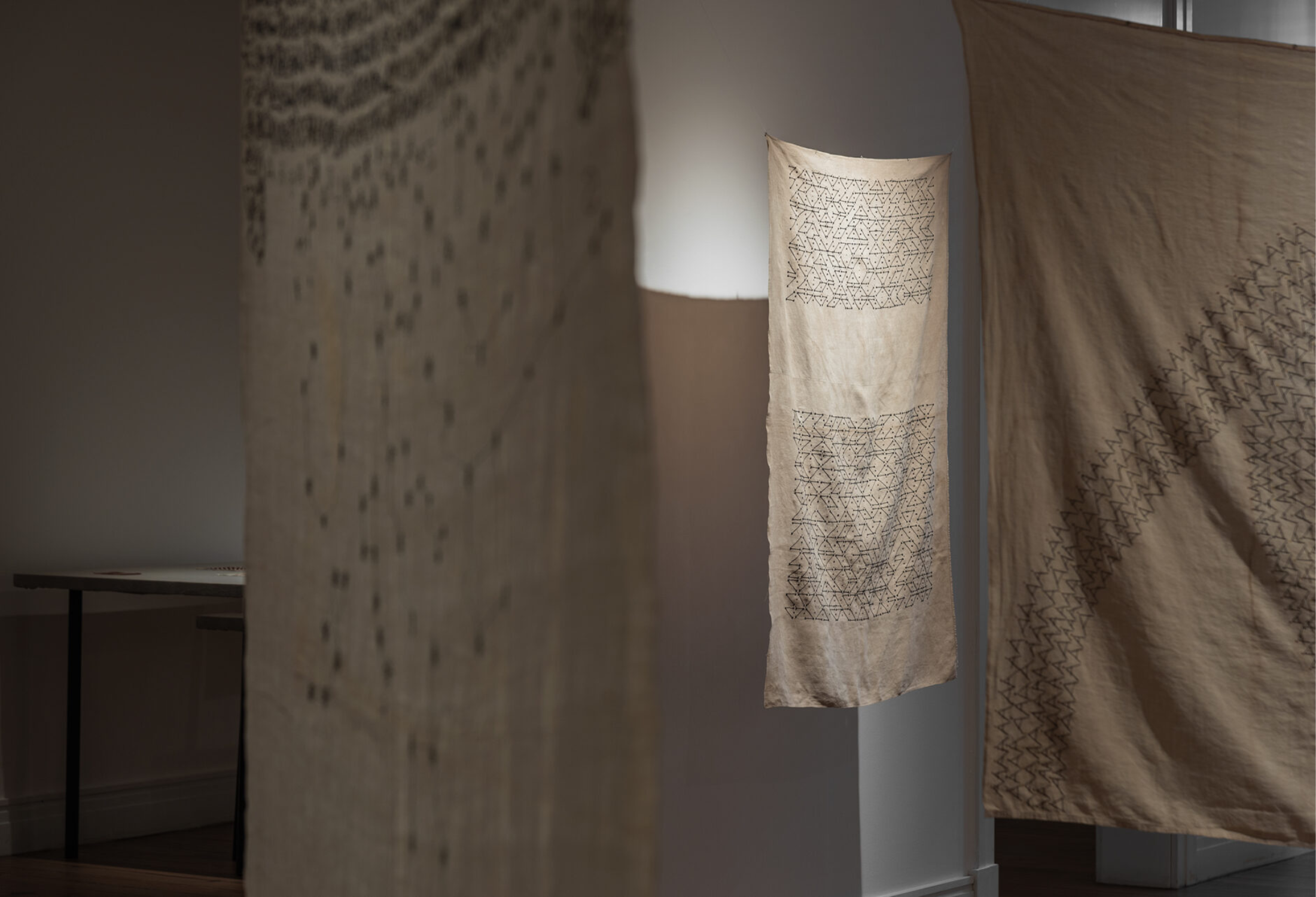
Since November 10th, the tapestries of Amparo de la Sota have embraced the walls of OTTODISANPIETRO. From her studio in Madrid, de la Sota creates in moments of silence and solitude. In those instants, through a conscious dialogue with thread and tapestry, unexpected and organic lines and paths emerge.

Her structures allude to geometry, inspired by the legacy of Paul Klee and Anni Albers. The result is a series of almost dreamlike tactile experiences, where the delicacy of embroidery unfolds over the history told by the canvases she chooses. We sat down with the artist, thanks to Galería Vilaseco, to speak about her memory, her work, her method, and the emotions and insights that arise from the process of creating beauty in silence.

8 QUESTIONS WITH ARTIST AMPARO DE LA SOTA

8 Questions with Amparo de la Sota

1. What do you consider to be your first work?

I wouldn’t know how to say. I started handling threads when I was very young, imitating my mother, picking up her crochet work and pretending to weave. For me, it was a game. And I’ve been there ever since, making and making. One thing leads to another, and then another, in a sequence that has neither a beginning nor an end.

2. What role does silence play in your creative process, beyond the physical act of embroidery?

I think the first thing that comes to mind when we hear the word silence is the absence of external noise. For me, true silence is the absence of internal noise, of thoughts. It’s a space that exists very deep within me, far back. It’s open, empty. It allows new ideas to emerge, it’s tremendously inspiring.

3. You say you repeat the same pattern until you find the right path. What sensation tells you that you’ve found it?

Curiously, it’s a physical sensation. What I feel is relaxation, a sense of wellbeing in the body. It comes after the tension of having been searching. I also feel as if I’m vibrating in tune with something I couldn’t define. Suddenly, the work begins to flow.

4. Is time an important material in your work?

It’s the first thing people notice in my work, the patience, the meticulousness. It is certainly another component. Beyond fabrics and threads, my embroideries are made of time. But each piece needs the time it needs. Large works require months of work, smaller ones hours or days. What matters is the result.

5. Would you say your background in Arabic philology influences your creative process?

What fascinated me most about Arabic was the writing. It’s very musical, it has a lot of rhythm. It made me aware of the beauty of signs when they are stripped of meaning. It introduced two elements that have been very present in my work ever since: letters and texts. Later I learned that text and textile have always been closely related. As Eduardo Galeano said:

Those who write, weave. Text comes from the Latin textum, which means fabric. With threads of words we speak, with threads of time we live. Texts are, like us, fabrics that walk.

6. You mention Anni Albers among your references. Her textile work has been the focus of Loewe’s latest collaboration.

My father had a wonderful library with many art books that I would spend hours looking through. I didn’t read them, I simply enjoyed contemplating the images. There were several books on the Bauhaus that I especially liked, because they included textile art. Gunta Stölzl’s work was mentioned, but interestingly, I don’t remember seeing anything by Anni Albers at that time.

My first real encounters with her work came through two exhibitions at the Reina Sofía Museum, one dedicated to Black Mountain College, and another focused on the travels she and her husband made to Latin America and the influence those journeys had on her work. I found it fascinating, so beautiful. And the fact that it was textile work shown in a modern art museum felt astonishing to me, deeply inspiring.

7. In your work and philosophy, patterns of uncertainty and enthusiasm for the creative process keep recurring. Would you say your work consciously resists the immediacy of today’s world?

I think I’ve been very fortunate to be able to live somewhat on the margins of the “current world.” For me, it has always been very important to have my own time and space to work freely, without schedules or external demands. I’ve been able to allow myself that silence I spoke about earlier. I enjoy exhibiting my work, but what matters most to me is having the time and space to work, to make.

8. What kind of relationship would you like the viewer to establish with your work?

I like the viewer to feel free to see whatever they wish in my work, without needing explanations. When people see my pieces, they often tell me they feel calm, a sense of stillness, of inwardness. And I like that. It’s as if, somehow, the sensations I experience while making the work are being transmitted.

Who is Amparo de la Sota?

Amparo de la Sota (Madrid, 1963) is one of the most singular voices in contemporary textile art in Spain. Born into a family of artists and architects, she grew up surrounded by books, fabrics, and geometries, an environment where visual language was as important as the spoken word. While she inherited her parents’ creative impulse, she chose a different and less conventional path: exchanging the paintbrush for the needle, and the immediacy of gesture for the meditative slowness of embroidery.

Her work, deeply rooted in textile tradition, revisits fabrics that carry the imprint of lived history: antique sheets, gauze, napkins, and tablecloths that once belonged to her mother, grandmother, and great-grandmother. Each piece thus becomes a point of connection with previous generations and with a practice that has historically been confined to the domestic sphere.

De la Sota transforms these inherited textiles into fields of exploration: signs, letters, maps, and graphic forms that evoke writing while resisting literal meaning. In her hands, embroidery becomes a form of visual meditation. A kind of writing that needs no words, guided instead by uncertainty, repetition, and an inner rhythm that emerges stitch by stitch. “I’m interested in not knowing,” she has said, and this state of unknowing becomes the means through which the work opens its own paths.

Her career began at a time when textile art was still fighting for institutional recognition. Over the years, she has consolidated a distinctive language that dialogues with art history, from Paul Klee to pre-Columbian traditions, through the influence of the Bauhaus and artists such as Anni Albers. Today, Amparo de la Sota stands as an essential figure for understanding how textile has reclaimed its place as a fully autonomous artistic language.

Join the conversation in our socials