Skip to content

OTTODISANPIETRO

Get our app ✨

Download

Cart

Your cart is empty

Select your gift wrapping

A NEW CHAPTER FOR CELINE

In a time of creative redefinition across fashion, Celine opens a new chapter marked by continuity under Michael Rider. The maison thus enters a new era guided by a figure who understands its history from within. After the impact of Hedi Slimane, Rider restores to Celine a more measured, human voice, one where style once again becomes a conversation between the wearer and the world they inhabit.

This blog explores the designer and his first two collections, Spring 2026 and Summer 2026, in which he has articulated a distinct language for the house built on familiar, emotional codes. Ultimately, this new era of Celine seeks to reconcile its different chapters and preserve the continuity of its legacy. Rider is not here to change its course, but to restore its meaning.

A NEW CHAPTER FOR CELINE

Who is Michael Rider

Michael Rider (Washington, D.C.) has been the creative director of Celine since January 2025. His appointment was announced by LVMH in October 2024 and took effect at the start of the following year. He oversees all creative divisions of the maison, womenswear, menswear, leather goods, accessories, and haute couture. Celine’s CEO, Séverine Merle, described his return as a natural choice, citing his intimate understanding of the house and his deep connection to its legacy. Rider himself defined Celine as a heritage “close to his heart,” one upon which he intends to build a new chapter.

His story weaves together meaningful layers. Born in Washington, D.C., and educated at Brown University, he worked as a teacher before becoming a designer. A discreet figure, absent from social media and surrounded by a tight-knit circle, Rider lets clothing speak in his place. That belief aligns perfectly with Celine, a house that, since its founding, has focused on transforming practical design into elevated luxury. Rider continues that timeline with confidence and serenity, restoring to Celine an authentic, necessary idea: to dress well as a form of connection with the world.

His training traces a remarkable triangle: Balenciaga under Nicolas Ghesquière (2004–2008), Celine with Phoebe Philo (2008–2018), and Polo Ralph Lauren (2018–2024). A path from pragmatism to modernity, reaching the quintessential American archetype. Three schools united by one obsession, wearable clothes elevated to objects of desire. Hence his sober tone, his faith in the power of styling, and his patient, detail-oriented eye. Those who have worked with him describe integrity and calm as his defining traits.

Rider keeps a low profile in the media and avoids overexposure. Colleagues emphasize his methodical approach: a focus on quality, durability, and style as an attitude, an aversion to excessive discourse, and a preference for product clarity.

He does not seek to rebuild Celine from the ground up ,neither out of necessity nor ambition. His aim is to synthesize, to harmonize the maison’s different eras and preserve what resonated most in each. His guiding principle is timelessness, understood not as nostalgia but as a difficult ideal. His July 6, 2025 debut embodied this vision: traces of Philo’s conceptual purity, Slimane’s precision, and Michael Kors’s American sportswear, all filtered through his own preppy sensibility. The debut’s New Celine Luggage bag, with its curved zipper forming a soft smile, became a symbol of this convergence of eras.

The debut: Celine Spring 2026

On July 6, 2025, under a grey Parisian sky over Rue Vivienne, Michael Rider presented his first show for Celine. The scene felt intimate, like a quiet ceremony filled with anticipation. The courtyard of the historic building housing the maison’s studio and atelier was covered by a vast silk scarf suspended between its walls, a poetic preview of the house’s new codes. The seats were arranged in the shape of the Triomphe, as if Celine’s emblem itself were welcoming a new era. In the front row, the cultural weight of the moment was palpable: BTS V arriving on a Celine bicycle, Kristen Wiig, Naomi Watts and her daughter Kai Schreiber, Alanis Morissette, Jonathan Anderson, Raf Simons, Law Roach, and Anna Wintour. The sound of rain became almost another guest, one that never disrupted the expectation in the air.

Rider’s arrival followed the Hedi Slimane era (2018–2024). Under Slimane, the maison removed the accent from “Céline,” introduced a new logo, launched menswear, and expanded its universe with fragrances (2019) and makeup. Financially, public estimates placed Celine’s revenue at around 2.6 billion euros in 2023, up from roughly 1 billion in 2018, making it one of LVMH’s leading fashion houses. That set a demanding benchmark for the new chapter.

Rider’s first collection, merging womenswear and menswear, established a shared point of departure, free from gender distinctions. He sought not to erase but to build upon what came before: the intellectual strength of Phoebe Philo and the bourgeois precision of Hedi Slimane. As he put it, “There was a solid foundation to build on. I didn’t want any sense of erasure.”

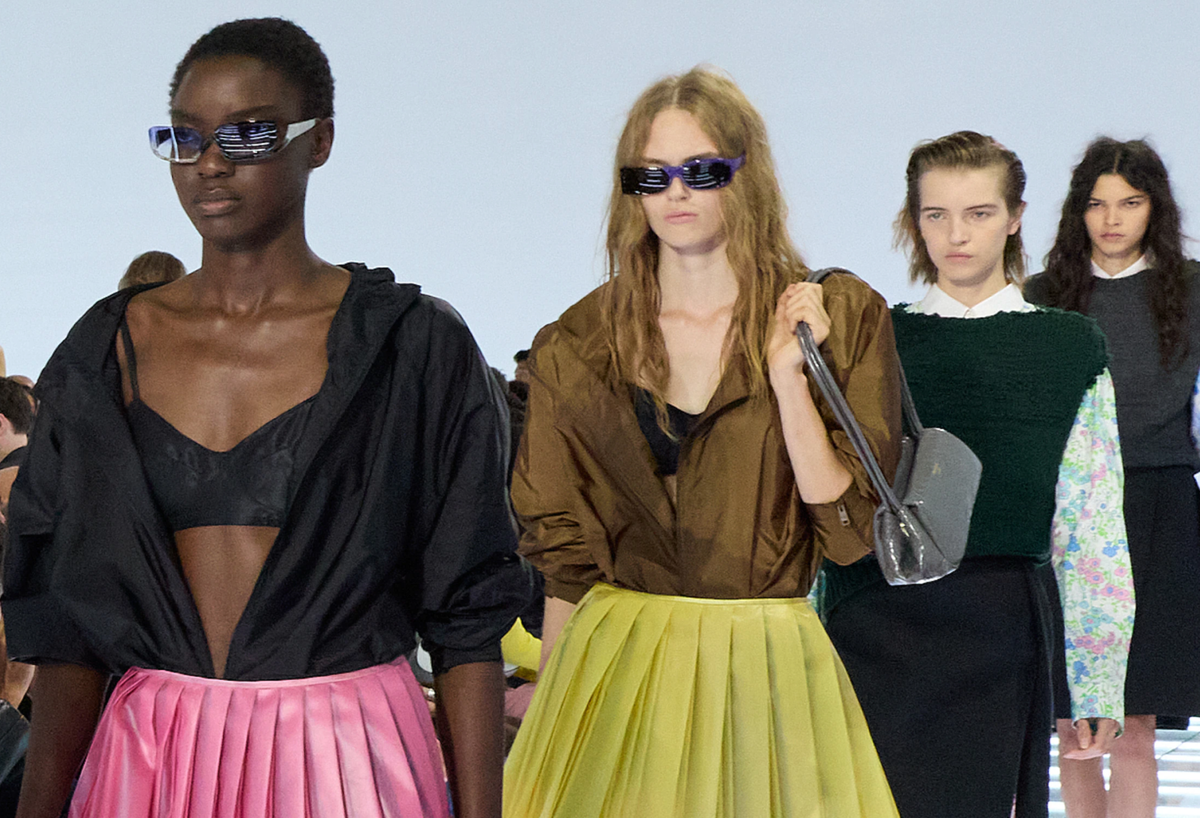
On the runway, the silhouettes hinted at smiles, like those on the bags. Camel blazers deliberately twisted over denim shirts and fitted trousers. Leggings, white jeggings, and equestrian pants revisited the appeal of skinny lines, while wide pleats and cocoon coats added lightness and movement. The collection embodied an active, vital Celine client, someone eager to move through the world. Long coats with padded shoulders, draped parkas, and soft leather biker jackets bridged Paris and New York. Rider’s preppy touch appeared with humor and grace: rugby shirts turned into dresses, red and blue blazers, tartan shirts, and supple leather loafers. For evening, a little black dress and a white gown symbolized the maison’s new duality.

Leather goods held the emotional center of the debut. Philo’s iconic Celine Luggage bag returned as the New Celine Luggage Smile Variation, its curved zipper forming a smile. New proportions, glossy lambskin, and shades of ultra blue and citrus set the tone for its global release. Rider has brought to Celine not rupture, but transition, a more human expression of Celine’s enduring elegance.

The Continuity: Celine Summer 2026

For his second collection, Michael Rider took Celine far from home, home being the original studio where he inaugurated his new chapter. About 45 minutes from Paris, the Parc de Saint-Cloud offered a setting of vast green lawns and clear blue skies, replacing the enclosed spaces of the impending fashion week. There, under natural light, Celine Summer 2026 unfolded: a show that extended and matured the narrative he had begun in July.

As if the July show had never really ended,” Rider wrote in his notes. “Women and men kept walking, and the seasons changed with them.” The idea materialized in a collection that revisited the spirit of Spring 2026 and carried it toward refinement. The silk scarves that once hung from the ceiling on Rue Vivienne became protagonists once again, now tied around the neck, draped into elegant evening tops, transformed into leather-handled totes, or simply knotted to a daily handbag.

The opening looks, 1960s-style floral babydoll dresses and a very short black mini, set the tone for what followed: a confident attitude, unafraid of color, exploration, or revealing the silhouette. From there, Rider unfolded a vocabulary that balanced structure and ease, echoing the tension between tailoring and sportswear seen in his debut. He personally handled the styling, highlighting a form of deliberate disarray: diagonally buttoned blazers, oversized beaded necklaces inspired by African craftsmanship, jackets and bags carried by hand, and even motorcycle helmets, a witty nod to the cosmopolitan Celine woman. The helmet felt like a response to the Celine bicycle from the previous show, now elevated to a motorbike in line with the collection’s maturity.

The result was a collection that masterfully reconciled Celine’s contrasting impulses: youth and rebellion meeting elegance and cosmopolitan polish. The codes of Philo and Slimane lingered in the precise proportions, the skinny jeans, and the artistic prints, but filtered through a distinctly American lens. The preppy-bourgeois language Rider introduced in July evolved here into a fully formed idiom for Celine: refined, modern, and full of vitality.

Primary colors ran as a visual thread throughout, red, blue, and yellow illuminated looks and accessories, while satin scarves cemented their role as the new signature piece of the Rider era. Multicolored necklaces and stacked rings amplified the playful energy. Altogether, the collection captured a summer optimism grounded in one essential idea: fashion as personal expression.

The History of Celine

The history of Celine is a succession of transformations that redefined the way elegance is presented. The house was founded in 1945, when Céline Vipiana and her husband, Richard, opened a children’s made-to-measure shoe boutique in postwar Paris. That small workshop on Rue Maltére soon became a reference point for comfort and refined functionality. In the 1960s, the brand expanded its universe into women’s prêt-à-porter, introducing a kind of sporty elegance to women’s fashion: skirt suits, ultralight fabrics, and highly practical accessories.

In the 1970s, Celine consolidated its international expansion and introduced its most recognizable emblem: the Triomphe, two interlocking Cs inspired by the chains surrounding the Arc de Triomphe. This motif, later reinterpreted by Hedi Slimane, became an unmistakable symbol of Celine’s identity. After the death of its founder, the maison was acquired by LVMH in 1996, integrating it into the group’s constellation of luxury houses.

From there, the brand entered its contemporary era. Michael Kors (1997–2004) brought a sporty sensuality that restored global visibility to the label. The arrival of Phoebe Philo in 2008 transformed Celine through her intelligent, conceptual minimalism. Her clean silhouettes, her vision of clothing as “to live in,” and her meticulous eye for detail marked a turning point that made Celine a cult name both within and beyond the industry. Under her direction, the maison became an aesthetic religion for a new generation of clients, the so-called Philophiles.

With Hedi Slimane (2018–2024), Celine entered a phase of commercial and stylistic rebirth. His rock-inflected precision and technical mastery tripled sales, establishing the brand as one of LVMH’s leading pillars.

Today, under Michael Rider, the house returns to its most essential vision: a union of heritage, modernity, and motion. From a children’s shoe workshop to the runway of the Parc de Saint-Cloud, Celine has traversed eight decades of history without ever losing its original spirit, to dress the present with the quiet confidence of those who move at their own rhythm.

Join the conversation in our socials