Skip to content

OTTODISANPIETRO

Get our app ✨

Download

Cart

Your cart is empty

Select your gift wrapping

THE NEW DIOR BY JONATHAN ANDERSON

Jonathan Anderson’s Dior occupies a point of complex balance. His personal history intertwines with a Dior that was seeking renewal, cohesion and a renewed connection with new audiences and objectives. Rather than inaugurating a new era through rupture, Anderson proposes something less immediate and more enduring: a new system of reading Dior. A language capable of sustaining itself over time and of engaging with a new generation of clients without losing the depth and legacy that define Dior. In this blog, we explore the new paths this chapter sets in motion.

Very soon, we will welcome this vision to OTTODISANPIETRO women.

THE NEW DIOR BY JONATHAN ANDERSON

Jonathan Anderson’s debut at Dior womenswear

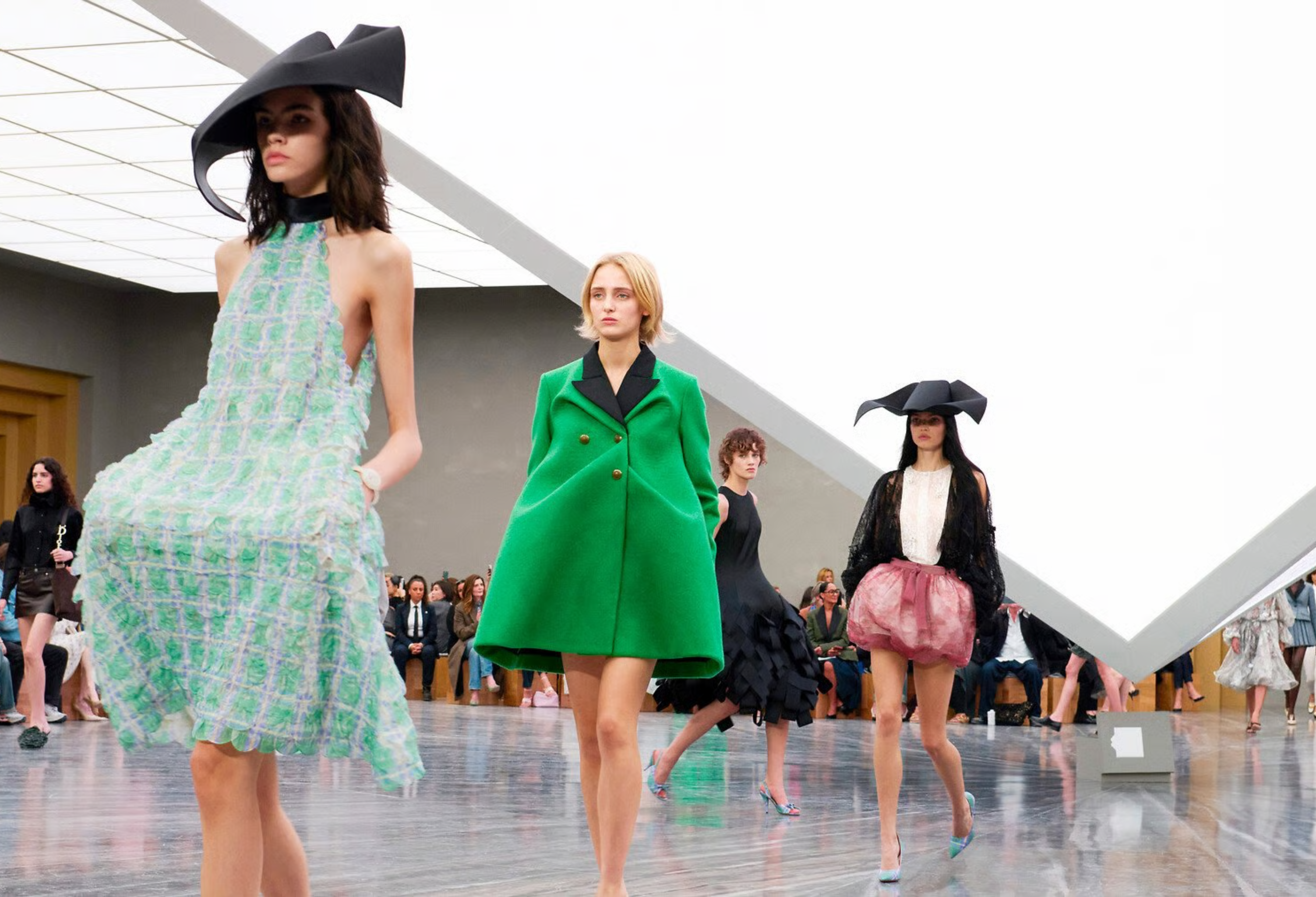
Contrary to many expectations, Jonathan Anderson’s highly anticipated womenswear debut at Dior did not unfold detached from what is familiar. His first show for Dior womenswear came across as a deep, meticulous and comprehensive reading of the path laid out by his predecessors. Anderson enters the Maison fully aware of the legacy he inherits and chooses to work from within the system. He does not pixelate it or blur it, but instead folds it in on itself with masterful precision. A true display of Anderson’s creative mastery. The Dior womenswear Spring–Summer 2026 collection serves as an inaugural chapter, one that reorganises Dior’s history and signals its future.

In fact, the first real public glimpse of Jonathan Anderson’s Dior came with the menswear show in June. Rich in preppy references and a formalism that was decontextualised and reformulated, it is in the women’s proposal presented in October that the project gains real density and momentum. Here, Anderson deploys a methodology already familiar from his time at Loewe: acting almost as an artistic curator of a collective rather than as a single, dominant author. Dior’s archive is treated as living material. The 1947 New Look reappears, but shrunken, shortened and subjected to a new sense of openness. The iconic Dior Bar Jacket is scaled down, altering its original proportions and rigidity without losing the sophistication that defines it. Despite initial doubts among some members of the audience, early client fittings of these reworked jackets have been an overwhelming success.

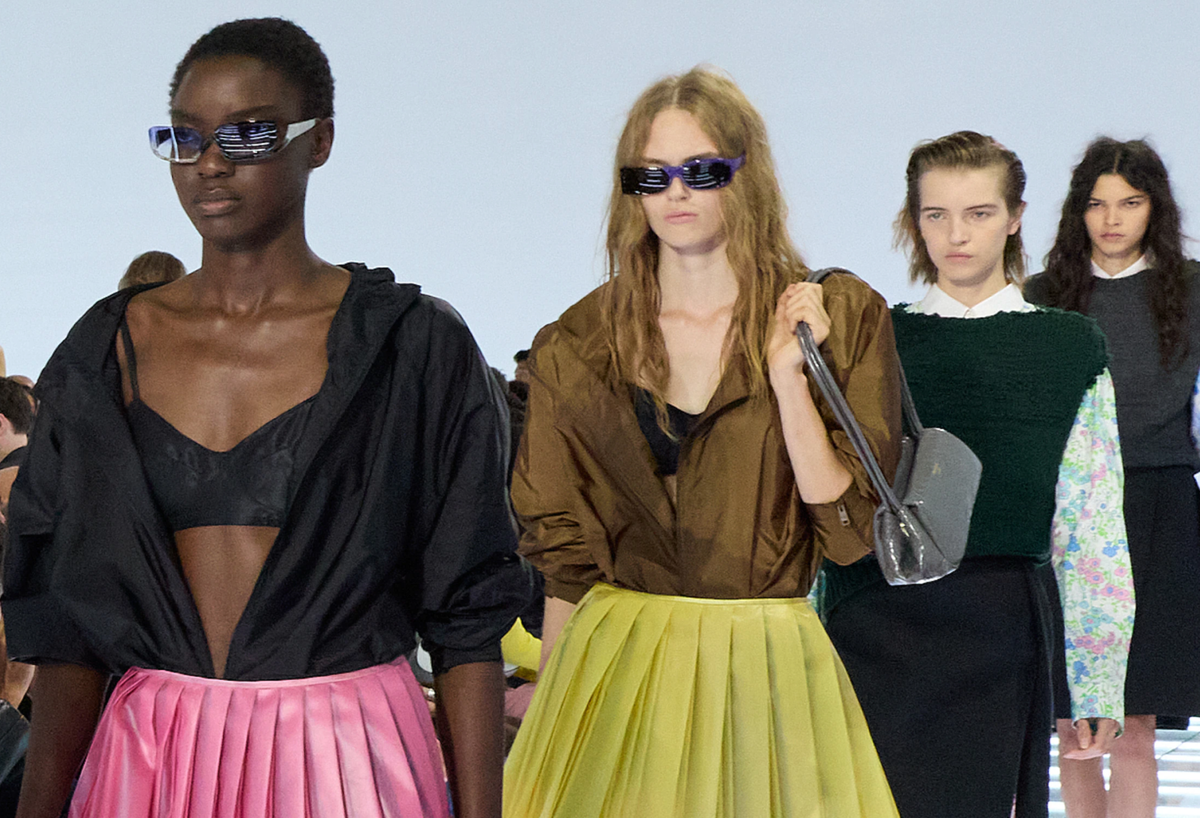
The collection unfolds through reinterpreted historical silhouettes and a sense of everyday magical realism. Eighteenth-century pannier dresses now coexist with miniskirts, shirts and flat shoes. Lace recalls the gaze of Yves Saint Laurent, sculptural volumes evoke Raf Simons, and more dramatic gestures speak to Galliano’s Dior. A more physical and sporty perspective is inherited from Maria Grazia Chiuri’s final years at the house. Everything passes through Anderson’s lens, which recalibrates draping, hems and internal structures.

The result is a collection that embraces Dior’s idea of “prettiness” without irony and with a certain ease, balanced by a notion of contemporary armour. Tailoring takes on an almost protective role, while dresses contrast their material lightness with powerful silhouettes and forms that sway with the models’ movements. Beauty is presented as a response to a complex context. In this new Dior for women, history becomes a tool of cultural memory.

Building the new world of Dior womenswear

Jonathan Anderson’s new universe at Dior is an intimate representation of Christian Dior’s imagination, including its most superstitious side. The opening scene of his show, an Adam Curtis pyramidal projector, condensed the ghosts of the past in order to present and acknowledge them. Dior thus appears as a “haunted house” that accepts its memory as a functional device, almost exposing the magic and Anderson’s own nerves as he steps into the Maison.

The first key lies in a continuous dialogue between masculine and feminine. For the first time, a single creative director draws the complete conversation across all the house’s lines. The result is a series of shared elements such as Dior coats, ties, capes and tailoring. All are crafted in similar colours and laminated technical materials that move across collections and bodies. Womenswear adopts a direct, everyday neutrality while preserving the Maison’s more dramatic and dreamlike potential. Pannier dresses intertwine with shirts, miniskirts and flat shoes, establishing a distinction beyond the prêt-à-porter pieces shared by Dior men and women.

The conversation between realism and the ethereal is another central axis. Jonathan Anderson’s Dior insists on tailoring as a new form of contemporary armour. Sculpted Bar jackets with padded structures in horsehair or tweed with micro sequins coexist with dresses that seem built from ether. Technical fabrics converse with couture materials, weaving a new representational system for Dior clothing. This new Dior invites a more contemporary, tactile experience, nourishing the Maison’s emblematic luxury with references to uniforms past and present.

In accessories, details and jewellery, symbols of Dior’s good luck appear, such as the four-leaf clover. Natural elements like insects and garden creatures evoke the talismans that Christian Dior himself kept in his home and atelier. Accessories such as Dior flower shoes and literary references translated into bags, together with the renewed Lady Dior, anticipate a strong, symbolic and continuous commercial universe. Anderson once again demonstrates the value of the object of desire, and his remarkable ability to turn it into image, moment and conversation.

Who is Jonathan Anderson?

Jonathan Anderson’s career is as complex and multifaceted as the results of his work. The winner of the Womenswear Designer of the Year Award (2025) was born in 1984 in Magherafelt, Northern Ireland. From a young age, he grew up in an environment marked by The Troubles, an experience he himself has described as formative, harsh and impactful, both personally and creatively. Paradoxically, his summers in Ibiza and the figure of his maternal grandfather, a textile designer specialised in hand printing, introduced him very early on to a direct relationship with material, colour and an appreciation for craftsmanship.

Before fashion, Anderson explored a different path. At 18, he moved to the United States with the intention of training as an actor, studying in Washington and immersing himself in musical theatre. The decisive turning point came when he realised that his true interest lay in building characters through what they wore, rather than inhabiting them viscerally. Back in Europe, his time in Prada’s visual merchandising department at Brown Thomas in Dublin, followed by his studies at the London College of Fashion, provided him with foundations that marked the beginning of his career, one defined by an understanding of fashion as a cultural construction rather than a product.

In 2008, he founded JW Anderson, initially as a menswear project and soon after as a hybrid laboratory where gender and volume became blurred. Critical recognition came quickly, with awards from the British Fashion Council, collaborations with Topshop and Uniqlo, and an increasingly influential presence in London. In 2013, LVMH acquired a minority stake in his brand and appointed him creative director of Loewe. There, over eleven years, he developed one of the most closely studied repositioning projects in contemporary luxury, centred on craftsmanship, contemporary art and formal experimentation within one of the market’s oldest fashion houses. He transformed Loewe from a niche leather goods brand into a major cultural reference and a key interpreter of the global fashion zeitgeist.

His work, almost a closing of the circle given his background in the performing arts, has recently expanded into cinema and audiovisual culture, collaborating as a costume designer with Luca Guadagnino on Challengers and Queer. He has also been behind iconic moments such as styling celebrities including Rihanna, Ariana Grande, Greta Lee, Josh O’Connor and Jamie Dornan. In 2025, Jonathan Anderson leaves Loewe and is appointed creative director of Dior, first at Dior Homme and subsequently at Dior womenswear and haute couture, becoming the first creative director in the house’s history to oversee all of its lines.

Anderson defines himself as someone obsessed with process, memory and the cultural responsibility of design. His vision understands fashion as a long-term discipline, one in which technique and history are woven together and, above all, guided by emotion. It is this sustained emotion that he now brings into the Dior universe.

Join the conversation in our socials