
VALENTINO: THE LEGACY OF THE GREAT
There are houses that define eras. Others go beyond, and transcend them. Since its beginnings in 1960s Rome, Valentino has remained a constant reference for beauty, power and sophistication. Beyond haute couture, it has become its own code. A language that evokes romance, luxury and precision. And one that has dressed princesses, screen stars and women who see fashion as an expression of their identity.

All of this has been achieved by Valentino through its metamorphoses. From the opulence of Valentino Garavani to the dreamier, more ethereal vision of Pierpaolo Piccioli, the house is now reinventing itself with the arrival of Alessandro Michele. It is not a blank page, but it is an opportunity to unearth the forgotten.
“I like the patina of dust that envelops the brand.
The dust is precious.”–Alessandro Michele
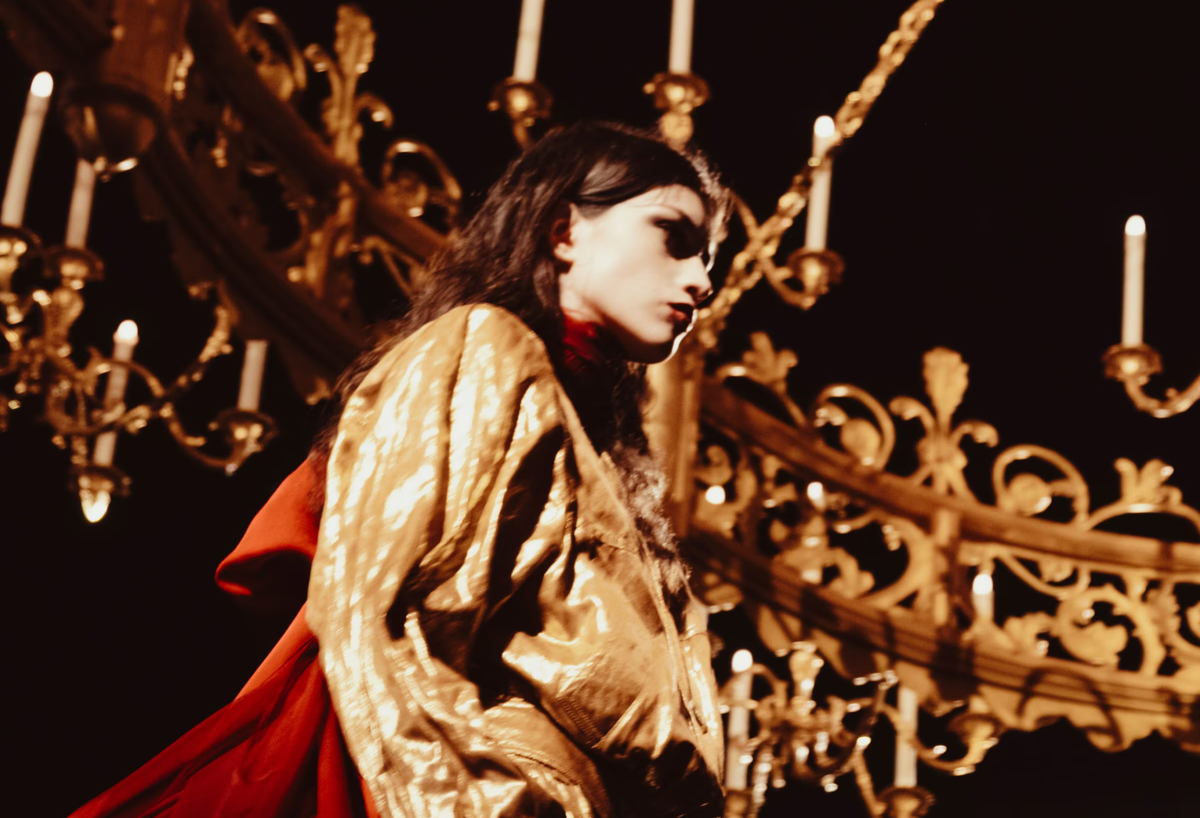
The maison thus opens a new chapter. A more baroque, more spiritual, and deeply theatrical era. The new and the forgotten meet and coexist, like spectres in a royal 17th-century palace, in all their splendour.
Let us then talk about Valentino’s journey to date, from a young man with a dream to a fashion house of imposing proportions.
When and how did the Valentino house begin?
The story of Valentino begins with a journey to Paris. Its founder and first creative director, Valentino Clemente Ludovico Garavani, was born in 1932 in Voghera, a small town in northern Italy. At 17, he decided to move to Paris, the undisputed capital of haute couture, to study at the École des Beaux-Arts and at the Chambre Syndicale de la Couture Parisienne. After completing his formal studies, he entered the ateliers of Balenciaga, Jean Dessès and Guy Laroche. However, it was not long before he sought to forge his own path.
 Valentino Fall/Winter 1986 by Oliviero Toscani
In 1959, he returned to Rome and opened his first atelier on Via Condotti with his father's help. Just one year later, in 1960, he met Giancarlo Giammetti. An architect by training, Giammetti became his partner, both professionally and personally, and the structural pillar of Maison Valentino. Together they founded Valentino with a very clear division of roles: Garavani as the absolute creator and Giammetti as the strategic and business brain. In business terms, success came quickly.
In 1962, they presented their first haute couture collection at the Palazzo Pitti in Florence. It was an immediate success. Valentino caught the attention of aristocrats, actresses and first ladies such as Audrey Hepburn and Jackie Kennedy. Thus, with a single show, the path was set for one of the most emblematic couture houses of the 20th and 21st centuries. On its firm foundation in Italian tradition, it built a global gaze towards the upper classes and the jet set.
The Valentino Garavani Era (1960–2007)
Valentino Garavani built an entire ideal around his brand. From his earliest designs, his vision for women was clear: to sublimate and elevate femininity through a classically inspired elegance, almost romantic and architectural, but always ultra-feminine. Since childhood, he had shown a clear vocation for becoming a designer, and a deep fascination with silver screen stars. His work became associated with elite sophistication, thanks to a visual language defined by clean lines, exquisite volumes, spectacular embroidery and masterful use of colour. The Valentino Red, in particular, became his emblem to this day.
 Valentino 'La Dolce Vita' campaign with Claudia Schiffer (by Arthur Elgort)
Its origin, the dress “La Fiesta”, a strapless red tulle gown presented in 1959 (even before his first show), marked the birth of the colour Valentino Red. Years later, the colour was established as the brand’s chromatic identity, eventually having its own Pantone. Interestingly, it is said that Garavani fell in love with the shade during a stay in Spain, after seeing several women and even the protagonist of Bizet’s opera Carmen wear it with strength and drama. The film Pretty Woman (released in 1990) established Valentino Red in the global imagination, far beyond an industry that already associated it with the house.
 Valentino Fall/Winter 2000 by Steven Meisel
His early campaigns and collections were full of glamour and opulence, with couture and colour flourishes that dressed such emblematic women as Jacqueline Kennedy, Elizabeth Taylor, Audrey Hepburn and Princess Diana. With each, he cemented his place in fashion history as the designer for the most powerful, iconic and romantic women.
By 2008, after a 48-year career, he bid farewell with a Spring Haute Couture collection in which every model wore a red dress. A moving finale for a career that changed the course of Italian and international fashion.
When did Pierpaolo Piccioli arrive?
Pierpaolo Piccioli and Maria Grazia Chiuri joined Valentino at the request of Valentino Garavani himself in 1999. From then until 2007, they were in charge of the brand’s accessories line. When Garavani retired, the Maison entered a new phase.

After a brief stint by Alessandra Facchinetti, the creative legacy of the house was entrusted to the duo Piccioli and Chiuri. Together, they redrew the house’s vocabulary, bringing in a greater sense of delicacy, romance and dreamlike reflections. But it was Piccioli, after Chiuri’s departure in 2016, who led the house into one of its most defining eras.
Since his appointment as sole creative director, Piccioli worked (successfully) to strike a balance between tradition and creative avant-garde. Respectful of the maison’s codes, such as haute couture and Valentino Red, his couture shows left no one indifferent. He brought technological innovation to couture, with new cutting, die-cutting, embroidery and even 3D modelling techniques.

Famously, he also introduced a new colour: Pink PP, developed with Pantone. The pieces from this collection, launched in 2022, dominated the international scene and made pink the world’s top colour for several seasons. His influence remains visible in the evolution of hyper-femininity in its many industry interpretations. Under his leadership, the brand adopted a more inclusive, emotional and conceptual aesthetic stance. All until 2024.
What is Alessandro Michele’s Valentino like?
In 2024, Valentino begins its new chapter with the arrival of Alessandro Michele as creative director. His appointment sought to reconnect with the glamorous and opulent roots of the brand. Born in Rome, raised among memories of taffeta, sequins and dresses from his mother’s wardrobe, Michele returns to his city with the mission of revitalising the Maison through respect. From the origin.

His baroque and nostalgic aesthetic enchanted the fashion public during his tenure at Gucci (from 2015 to 2022). Now, it intertwines with the rich legacy of Valentino Garavani. Michele does not aim to reinvent, but rather to recover old archives, fabrics, patterns and essences, and transform them with a maximalist and theatrical sensitivity.
The opulence of Michele’s vision for Valentino is paired with more punk gestures, such as a self-referential perspective on the brand. His debut show, held in a martial arts dojo on the outskirts of Paris, was a melancholic and exuberant procession of loaded looks and stunning pieces. A Rococo parade walking over broken glass on the floor, adding drama.

For Michele, the Valentino archive is a sacred source. He inhabits it fully, and seeks, like water: “to slip through a small crack and destroy what is contained.” Each piece contains a dialogue, a dichotomy, a tension between past and present. Between rebellion and glamour. Between the genius of Garavani and that of Michele.
As Valentino’s CEO Jacopo Venturini expressed: “It’s not a blank page.” And Alessandro Michele knows it: his task is to keep the flame alive. The burning flame of Valentino Garavani’s original passion.